
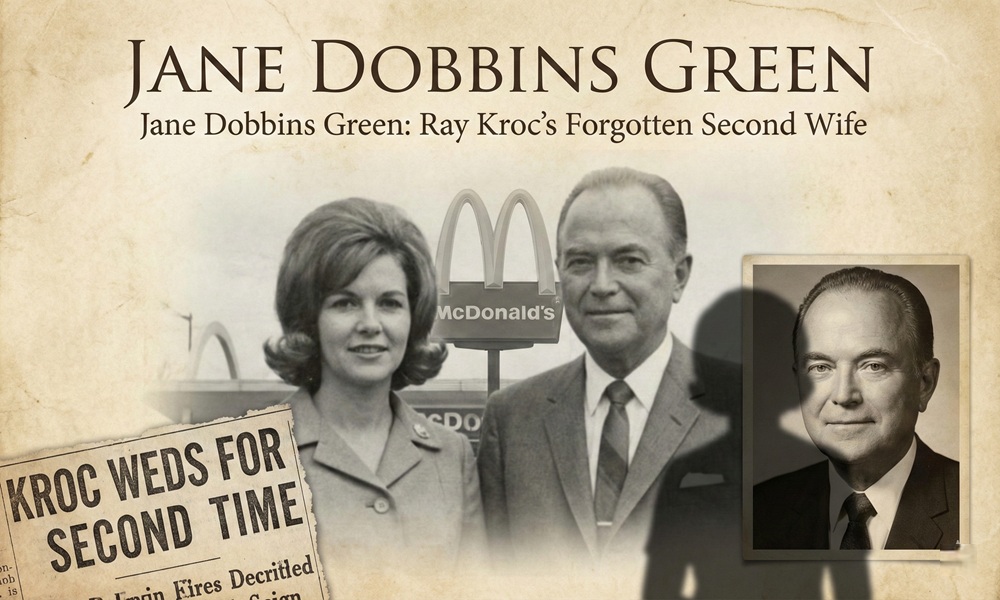
Behind every iconic name in business history lies a web of personal stories that rarely make the headlines. Jane Dobbins Green is one such story. She was the second wife of the late business mogul Ray Kroc, married for five years during the 1960s, a period when McDonald’s was transforming from a regional burger chain into a global fast-food empire. Yet despite living through one of the most pivotal chapters in American corporate history, Jane’s story was never fully told — not in biographies, not in documentaries, and barely in the press. This article sets the record straight.
Who Was Jane Dobbins Green?
Jane Dobbins Green was born on 22 November 1911 in Walla Walla, Washington, to Myrtle Duncan Frechette and Warren David Dobbins. She was raised in the United States and led a largely private life before fame found her through marriage. Of white Caucasian ethnicity and American nationality, Jane maintained a quiet, reserved personality that contrasted sharply with the world of high-stakes business she would briefly enter.
Very little is documented about her childhood, formal education, or early ambitions. What is known is that she grew into a composed, dignified woman whose preference for privacy would define her entire life — both before and after her marriage to one of the most powerful men in America.
Quick Facts at a Glance
| Detail | Information |
|---|---|
| Full Name | Jane Dobbins Green |
| Date of Birth | November 22, 1911 |
| Place of Birth | Walla Walla, Washington, USA |
| Nationality | American |
| Ethnicity | White / Caucasian |
| Height | 5 feet 6 inches (168 cm) |
| Weight | Approx. 121 lbs (55 kg) |
| Married To (1st) | Ray Kroc (1963–1968) |
| Married To (2nd) | Paul D. Whitney (1984 – until death) |
| Date of Death | August 7, 2000 |
| Place of Death | Los Angeles, California |
| Resting Place | Westwood Memorial Park, Los Angeles |
Career: From Hollywood Secretary to Celebrity Wife
Before meeting Ray Kroc, Jane worked as a secretary to Hollywood icon John Wayne. It was an intriguing role for a woman who would later become known primarily through the world of fast food. The position placed her at the intersection of celebrity culture and professional life at a time when such careers for women were relatively rare and prestigious.
Beyond this notable role, her professional life remains largely undocumented. Unlike Kroc’s later wife, Joan, who became deeply involved in philanthropy, Jane appears to have maintained a more private and low-profile lifestyle. There are no verified reports of long-term business ventures or professional pursuits after her time as a Hollywood secretary, which underscores how deliberately she kept herself out of the public eye.
Meeting Ray Kroc: A Quiet Beginning to a Complicated Romance
Jane met Ray Kroc while playing the organ at the Criterion Restaurant in St. Paul, Minnesota, in 1957. At the time, Ray was 26 years her senior. Their meeting was casual, almost accidental — two people from very different worlds crossing paths over music and meals. Ray was already deep in the process of revolutionizing McDonald’s, driven by ambition and restless energy, while Jane offered something quieter and steadier.
What makes their love story even more layered is the context surrounding it. Long before he met and married Jane, Ray had been developing feelings for Joan Beverly Kroc (then Joan Smith) while he was still married to his first wife Ethel. Ray and Joan had met at a restaurant event in 1957, and he had been immediately struck by her. However, Joan succumbed to societal and family pressure to end the relationship, and they went their separate ways.
With Joan out of the picture — at least temporarily — Ray turned toward Jane.
Marriage to Ray Kroc (1963–1968)
Their connection led to marriage on February 23, 1963. It was a significant milestone for both of them. Ray was riding the peak of his McDonald’s expansion, building the brand’s foundation across the United States, while Jane stepped gracefully into the role of the businessman’s wife.
Their relationship progressed rapidly — dinners led to marriage within weeks, a whirlwind union that occurred during a complicated period in Ray’s life. The couple settled in a home in Woodland Hills, California, reportedly with a view of a McDonald’s restaurant from their property — a symbolic detail that speaks volumes about how thoroughly McDonald’s dominated Ray’s world.
What Their Marriage Looked Like
During their five years together, Jane played the role of the supportive, behind-the-scenes partner. She was never involved in the McDonald’s business publicly, never sought media attention, and reportedly maintained a calm domestic life while her husband dealt with one of the most turbulent and exciting periods in American corporate history. Jane, who had a gentle and easygoing nature, provided Ray with a comforting contrast to his other more intense relationships.
However, beneath the surface, the marriage was already shadowed by unfinished emotional business.
Why Did They Divorce?
The marriage was shadowed by Ray’s unresolved feelings for Joan, making his life with Jane more of a placeholder than a partnership. The relationship ended in 1968, clearing the path for Ray’s subsequent marriage to Joan the following year.
In short, Jane Dobbins Green was caught in the middle of a love story that had never truly ended. Ray had never stopped loving Joan, and once Joan became available, the outcome was almost inevitable. Ray Kroc divorced Jane Dobbins Green in 1968 because of his continuing feelings for Joan Smith, whom he later married in 1969.
The couple had no children together, and the divorce was finalised without significant public drama — just another quiet chapter in Jane’s quietly lived life.
Ray Kroc’s Three Marriages: A Comparison
To understand Jane Dobbins Green’s place in history, it helps to see all three of Ray’s marriages side by side.
| Wife | Marriage Years | Duration | Children Together | Notable For |
|---|---|---|---|---|
| Ethel Fleming | 1922–1961 | ~39 years | 1 (Marilyn Kroc) | First and longest marriage |
| Jane Dobbins Green | 1963–1968 | 5 years | None | Overlooked chapter; quiet, private spouse |
| Joan Beverly Kroc | 1969–1984 (Ray’s death) | ~15 years | None (stepdaughter) | Philanthropy; inherited $600M+ estate |
Life After Ray Kroc
Following her divorce from Ray, Jane did what she had always done — she disappeared from the spotlight, completely and deliberately. She made no public statements, gave no interviews, and maintained no association with the McDonald’s brand or Ray’s expanding legacy.
In 1984, she tied the knot with Paul D. Whitney. Their marriage lasted until she died. Her second marriage, far from the glare of celebrity or corporate fame, appears to have been exactly what Jane always wanted: private, stable, and peaceful.
Jane Dobbins Green died on 7 August 2000 in Los Angeles, California, at the age of 88, and was laid to rest at Westwood Memorial Park in Los Angeles. The cause of death was natural — old age.
The Founder (2016): Why Jane Was Left Out
One of the most telling aspects of Jane Dobbins Green’s legacy is what was not said about her. The 2016 documentary The Founder focuses on Kroc’s role in the expansion and success of McDonald’s, capturing his ambitious drive and complex relationships. Despite its detailed portrayal of his business acumen and interactions with his first and third wives, the film notably omits any mention of Ray’s second wife, Jane.
This absence is not merely a cinematic oversight — it reflects a deeper historical pattern of erasing the women who occupied transitional spaces in powerful men’s lives. Jane was neither the devoted first wife nor the glamorous philanthropist third wife. She existed in between, and history treated her accordingly.
Her exclusion from The Founder has since drawn attention from researchers and pop culture commentators who see it as a missed opportunity to present a fuller, more honest picture of Ray Kroc’s personal life.
Common Confusion: Jane Dobbins Green vs. Author Jane Green
A notable point of confusion worth addressing: Jane Dobbins Green is frequently confused with Jane Green, an English-born American author renowned for her contributions to commercial women’s fiction. This mix-up has led to numerous incorrect mentions in online tabloids, attributing literary achievements to Jane Dobbins that actually belong to another.
The two women share nothing beyond a name. Jane Dobbins Green was a private American socialite, while the author Jane Green — born in 1968 — is a celebrated novelist whose books have sold over 10 million copies worldwide and been translated into 31 languages.
Net Worth and Financial Legacy
Jane Dobbins Green’s personal net worth was never publicly disclosed, and she left no known financial legacy tied to McDonald’s or Ray Kroc’s fortune. At the time of his death, Kroc’s net worth was estimated at $600 million, which amounts to more than a billion dollars today after inflation adjustments. This fortune was inherited by his third wife, Joan Kroc.
Jane, having divorced Ray in 1968 — well before his peak wealth accumulation — received no share of that estate. Whatever divorce settlement she received (if any) has never been made public.
Key Takeaways: What Jane Dobbins Green’s Story Teaches Us
Jane Dobbins Green’s life is brief in its public chapters but rich in the lessons it offers:
- Privacy is a choice, not a failure. In an era of celebrity obsession, Jane chose anonymity — and lived a full life on her own terms until she was 88.
- History forgets the middle. Those who occupy transitional roles in powerful narratives are often erased. Jane was neither beginning nor end in Ray Kroc’s story, so she was largely left out of it.
- Dignity without recognition is still dignity. Jane never sought validation through her association with McDonald’s fame. She lived, loved, and passed away quietly — and there is a certain grace in that.
- Behind every famous story are untold ones. The McDonald’s golden arches carry the stories of many people — the brothers, the franchisees, the wives. Jane Dobbins Green is one of the quiet voices behind the golden arches.
Final Thoughts
Jane Dobbins Green may not have a chapter in any major biography, a mention in The Founder, or a foundation bearing her name — but her story is a meaningful footnote in one of the greatest business narratives in American history. She was a woman who entered a whirlwind, held her ground with grace, and chose a quiet life when the storm passed.
In understanding Jane Dobbins Green, we understand a fuller version of Ray Kroc — and a more honest picture of what it means to live beside greatness without ever seeking it for yourself.
