
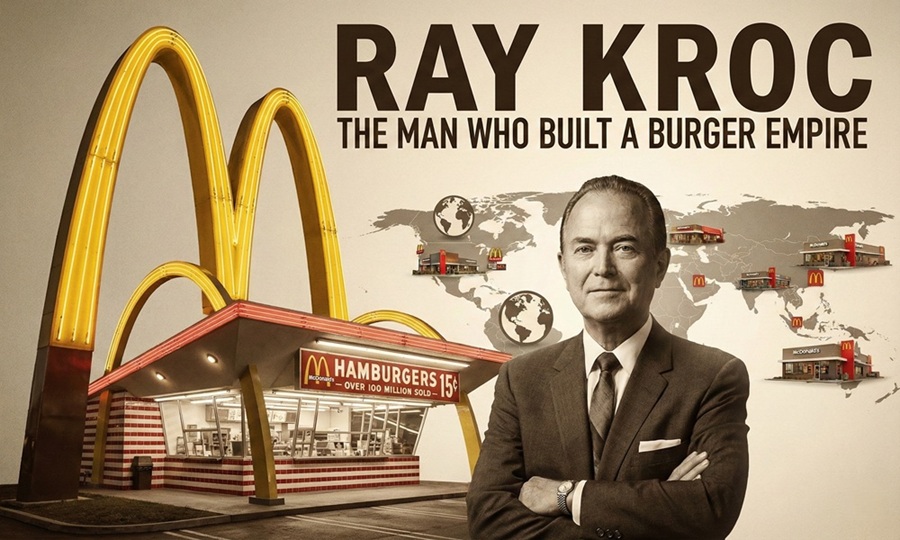
Ray Kroc did not invent the hamburger. He did not even found McDonald’s. Yet his name is synonymous with one of the most powerful brands in human history. Raymond Albert Kroc (October 5, 1902 – January 14, 1984) was an American businessman who was instrumental in turning McDonald’s into the most successful global fast food corporation by revenue. His story is one of relentless ambition, obsessive perfectionism, and a late-blooming genius that did not truly ignite until he was past 50.
Early Life: A Salesman in the Making
Kroc was born in Oak Park, Illinois, and worked a variety of jobs, including as a paper cup salesman and a musician, before eventually becoming a milkshake mixer salesman. His parents were Czech-American immigrants, and the family tasted both prosperity and ruin — his father made a fortune in land speculation during the 1920s, only to lose everything in the 1929 stock market crash.
From an early age, Kroc showed a restless entrepreneurial spirit. He ran a lemonade stand as a boy and at age 15 lied about his age in order to join the Red Cross ambulance service on the front lines of World War I. He never made it overseas — the war ended first — but his boldness was already on full display.
After the war, Kroc drifted through careers with characteristic energy: jazz pianist, real estate salesman, radio DJ, and paper cup salesman for Lily-Tulip Cup Co. From 1938–1954, Kroc owned the Prince Castle Sales company which had exclusive rights to sell Multimixer machines that blended multiple milkshakes at the same time. It was through this venture that everything changed.
The Pivotal Moment: Meeting the McDonald Brothers
The Visit That Changed Everything
In 1954, he visited a hamburger restaurant in San Bernardino, California, owned by Richard and Maurice McDonald. Kroc was puzzled — and intrigued. The brothers had ordered eight of his multimixers, more than any restaurant he had ever encountered. He had to see why.
What he found stopped him cold. The McDonald brothers had built a revolutionary system called the “Speedee Service System” — an assembly-line approach to food preparation that produced hamburgers, fries, and milkshakes with jaw-dropping speed and consistency. The restaurant was spotlessly clean. The lines were long. The customers were happy.
Ray witnessed first-hand their booming hamburger, milkshake, and French fry take-out business. Kroc was impressed with their innovative, efficient food prep and delivery system which, combined with their limited menu items, enabled them to focus on quality, consistency, and quick service.
At 52 years old, Kroc had an epiphany: his future was in hamburgers.
Building the McDonald’s Empire
From Franchise Agent to Owner
Kroc was impressed with the efficiency and speed of the restaurant’s operations, and he convinced the brothers to allow him to franchise the concept. In 1955, he opened his first franchise location in Des Plaines, Illinois. First-day sales were $366.12 — modest by any measure, but the beginning of something extraordinary.
Kroc’s approach to franchising was different from the industry norm of his era. Most franchisors sold large territorial licenses to a few wealthy buyers. Kroc sold single-store franchises, insisting that owner-operators manage their own restaurants. This kept quality high and gave him far more control over the brand.
Key Milestones at a Glance
| Year | Milestone |
|---|---|
| 1954 | Kroc visits McDonald’s in San Bernardino; becomes franchise agent |
| 1955 | Opens first franchise in Des Plaines, Illinois (April 15) |
| 1961 | Buys out McDonald brothers for $2.7 million; 228 restaurants open |
| 1961 | Launches Hamburger University to train franchisees |
| 1963 | McDonald’s sells its one billionth hamburger |
| 1968 | Steps down as president; becomes chairman; 1,000th restaurant opens |
| 1970 | McDonald’s present in all 50 U.S. states |
| 1974 | Buys the San Diego Padres MLB team |
| 1976 | McDonald’s surpasses $1 billion in annual revenue |
| 1984 | Kroc dies; 7,500 McDonald’s outlets operating worldwide |
The $2.7 Million Buyout
By the time Kroc bought out the McDonald brothers in 1961 for a mere $2.7 million, he had established 228 restaurants and sales had reached $37 million. Judged against what the brand would become, this was perhaps the most undervalued transaction in business history. Kroc had promised the brothers a percentage of annual profits in addition to the buyout, but that agreement was never honored — a decision that became one of the enduring controversies of his legacy.
What Made Kroc a Business Genius
The Real Estate Revelation
One of Kroc’s smartest strategic moves was one he did not come up with himself. Harry Sonneborn, the McDonald’s Corporation’s first CEO and president, helped Kroc understand the importance of real estate and devised the strategy of owning land and leasing it to the franchisees. This turned McDonald’s into not just a fast food company, but a real estate empire. The corporation would buy or lease land and then sublease it to franchisees at a markup — creating a revenue stream that was entirely independent of burger sales.
Standardization as Strategy
Kroc was almost obsessive about uniformity. Realizing that franchisees were vital to the company’s success, Kroc developed exacting standards for how each McDonald’s should be run, from food preparation to cleaning. To ensure the standardized operation of the outlets, he created a program in 1961, later known as Hamburger University, to train franchisees.
The idea was radical at the time: a corporation that taught its franchisees like students, ensuring that a McDonald’s in Illinois felt — and tasted — identical to one in California.
Core Business Principles Kroc Championed
| Principle | Application |
|---|---|
| Uniformity | Identical menu, taste, and service across all locations |
| Owner-operated franchises | Franchisees must manage their own store, not delegate |
| Real estate ownership | McDonald’s owns the land; franchisees lease it |
| Standardized training | Hamburger University ensures consistent operator quality |
| Single-unit franchising | Avoided territorial deals to maintain brand control |
The Controversies Behind the Golden Arches
Kroc’s story is not without shadow. His 2016 biopic, The Founder, starring Michael Keaton, brought these tensions to mainstream audiences.
The McDonald Brothers’ Deal: The brothers never received the promised royalty percentage after the buyout. Dick and Maurice McDonald were left to live out their days comfortably but far from the billions their name would eventually generate. When Richard McDonald died in 1998, his estate was worth a reported $1.8 million — a fraction of what the brand had become.
Three Marriages: Kroc’s dedication to the business also strained his marriages. His first wife, Ethel Fleming, didn’t approve of his decision to sell milkshake machines or his obsession with the McDonald’s franchise. He married twice more, with his final and lasting marriage being to Joan Mansfield, who survived him and became one of America’s most significant philanthropists.
The Founder Debate: Kroc called himself the founder of McDonald’s — a claim he defended aggressively until his death. The McDonald brothers, history, and most business scholars say otherwise. What is undeniable is that without Kroc, the McDonald’s we know today would not exist in any recognizable form.
Personal Life and Philanthropy
Kroc was married three times: first to Ethel Fleming (1922–1961), then to Jane Dobbins Green (1963–1968), and finally to Joan Mansfield (1969 until his death). He had one daughter, Marilyn Kroc Barg, who died of diabetes in 1973.
Having amassed great wealth, Ray started the Kroc Foundation in 1965 and was its sole benefactor. The foundation supported research on diabetes (which killed his daughter Marilyn in 1973), arthritis, and multiple sclerosis.
He also owned the San Diego Padres baseball team from 1974 until his death, though his tenure as an owner was as colorful and controversial as the rest of his life — at one point grabbing the stadium microphone during a game to publicly berate his team’s poor performance.
Ray Kroc’s Legacy: What He Left Behind
Kroc died of heart failure in San Diego, Calif., on January 14, 1984 at age 81. At that time, McDonald’s Corporation had 7,500 restaurants across nearly 36 countries, was valued at about $8 billion dollars, and had sold its 50 billionth hamburger.
Today, McDonald’s operates over 40,000 locations in more than 100 countries, serving roughly 69 million customers daily. The company is one of the most valuable brands in the world, consistently ranked among the top 10 global brands by revenue and recognition.
Kroc’s wife Joan carried his philanthropic vision forward on a massive scale. She donated hundreds of millions of dollars to causes ranging from National Public Radio to disaster relief, making the Kroc name as synonymous with generosity as it is with hamburgers.
Lessons from Ray Kroc’s Life
Ray Kroc is studied in business schools around the world — not just as a fast food mogul, but as a case study in vision, persistence, and the mechanics of scaling an idea. Here are the most enduring insights from his journey:
1. It is never too late to find your calling.
Kroc was 52 when he walked into a San Bernardino burger restaurant. Most people at that age consider their careers settled. He was just getting started.
2. Systems beat talent.
Kroc did not rely on hiring the best cooks or managers. He built systems — the Speedee Service System, Hamburger University, standardized recipes — that made human variation almost irrelevant. The system was the product.
3. Own the asset, not just the business.
The real estate strategy was what made McDonald’s invincible. Kroc did not just sell burgers; he controlled the land beneath the restaurants. This gave the corporation leverage that no competitor could easily replicate.
4. Obsession has a cost.
Kroc’s relentless work ethic built an empire but cost him two marriages and strained countless relationships. His story is a reminder that ambition without balance has real human consequences.
5. Vision requires execution.
The McDonald brothers had the idea. Kroc had the drive. Both were necessary. Great ideas without execution remain small restaurants; great execution without a worthy idea produces nothing memorable.
Conclusion
Ray Kroc remains one of the most fascinating figures in American business history — admired, criticized, and impossible to ignore. He did not invent the fast food industry. He did not invent the franchise model. What he did was look at a single hamburger stand in California and see something no one else could: a system worth replicating ten thousand times over.
His story is a testament to the power of timing, tenacity, and the willingness to bet everything on an idea — even at an age when most people have stopped betting. Whether you view him as a visionary builder or a ruthless operator, one fact is undeniable: the world Ray Kroc helped create feeds tens of millions of people every single day.
“Luck is a dividend of sweat. The more you sweat, the luckier you get.” — Ray Kroc
