
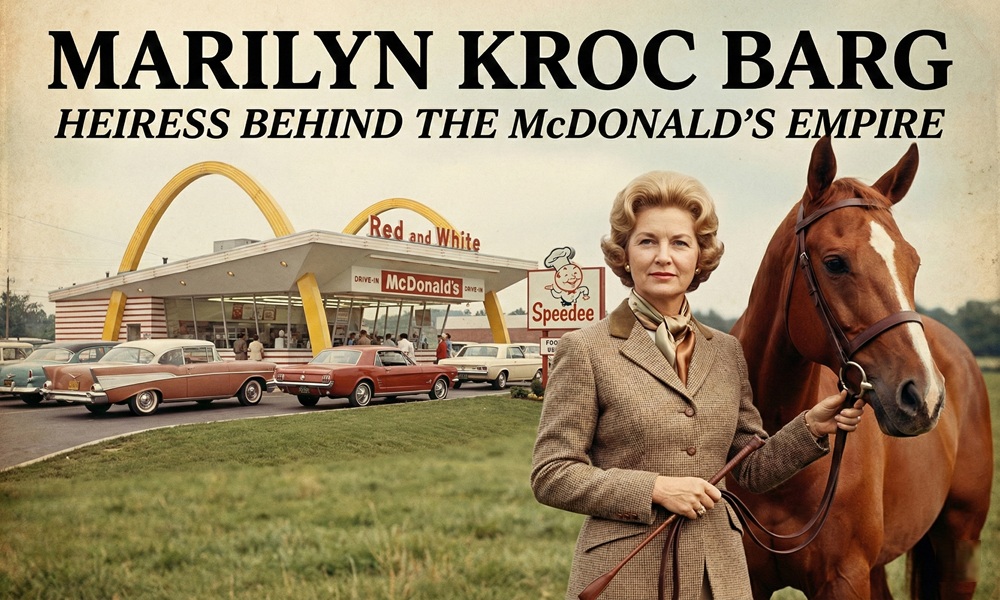
Who Was Marilyn Kroc Barg?
When most people hear the name “Kroc,” golden arches flash through their minds almost instantly. Ray Kroc — the relentless salesman who transformed a small California burger stand into the most recognized fast-food empire on the planet — has been celebrated in books, documentaries, and Hollywood films. Yet the story of his only child, Marilyn Kroc Barg, remains quietly tucked behind the glare of that corporate spotlight.
Marilyn wasn’t a CEO, a brand ambassador, or a tabloid fixture. She was something rarer: a woman connected to enormous wealth and global influence who deliberately chose privacy, personal values, and charitable giving over fame. Her story is one of quiet resilience, and it deserves to be told in full.
Quick Facts at a Glance
| Detail | Information |
|---|---|
| Full Name | Marilyn Janet Kroc Barg |
| Date of Birth | October 15, 1924 |
| Place of Birth | Chicago, Illinois, USA |
| Father | Ray Kroc (McDonald’s founder) |
| Mother | Ethel Janet Fleming |
| Marriages | Sylvester Nordly Nelson (1st); James W. Barg (2nd, May 28, 1960) |
| Children | One daughter, Linda Smith |
| Date of Death | September 11, 1973 |
| Age at Death | 48 |
| Cause of Death | Complications from diabetes |
| Known For | Philanthropy, privacy, Ronald McDonald House Charities connection |
Early Life: Growing Up in the Shadow of Ambition
Marilyn Janet Kroc came into the world as the only child of Ray Kroc and Ethel Fleming. Born on October 15, 1924, in Chicago, Illinois, she grew up amidst the burgeoning Golden Arches, yet charted a course defined not by hamburgers and milkshakes, but by quiet philanthropy and a deep-seated desire for privacy.
Her early years were shaped by a father whose ambition was already restless and relentless, though McDonald’s itself hadn’t yet become a household name. Ray Kroc spent those years working as a milkshake machine salesman, pitching the MultiMixer across the country. The family lived modestly in Oak Park, Illinois — a suburban upbringing far removed from the corporate boardrooms Ray would later command. Ethel Janet Fleming played a crucial role in Marilyn’s early years by providing a stable and loving home. Ethel’s care and support helped shape Marilyn’s strong values, including humility and kindness.
Growing up during the 1930s and 1940s, in the aftermath of the Great Depression, gave Marilyn a grounded perspective that wealth and celebrity never erased. Her upbringing placed more emphasis on stability, education, and strong moral values, a foundation that would define every chapter of her adult life.
The McDonald’s Era: A Front-Row Seat to History
Ray Kroc struck his famous deal with brothers Richard and Maurice McDonald in 1954, and by 1955, the first Ray Kroc-franchised McDonald’s opened in Des Plaines, Illinois. Marilyn was already 30 years old by this point — old enough to witness her father’s extraordinary gamble up close.
What It Meant to Watch McDonald’s Rise
For Marilyn, the McDonald’s story wasn’t an abstract business legend. It was her family’s reality unfolding in real time. While her father was expanding the McDonald’s universe — opening new stores, signing new franchises, and changing the way Americans ate — Marilyn Kroc Barg stayed focused on her own path.
She represented the side of the McDonald’s story that didn’t make headlines — the personal conversations, family moments, and shared experiences that happened away from the boardroom.
Crucially, Marilyn never sought a role within the company. She chose to live a private life and did not play a role in the company’s leadership. In an era when corporate dynasties often drew their heirs into executive positions, Marilyn’s deliberate absence from the business is itself noteworthy.
Personal Life: Marriages and Family
Marilyn’s personal life, like her philanthropy, remains largely private. She was married twice. Her first marriage, to Sylvester Nordly Nelson, is veiled in obscurity. Details are scarce, reflecting her desire to keep her personal affairs out of the public domain. Her second marriage, to James W. Barg on May 28, 1960, also did not result in any children.
She did, however, have at least one child from an earlier relationship — a daughter named Linda Smith, who has also maintained a low public profile.
Marilyn lived in Evanston, Illinois, before eventually moving to Arlington Heights — quiet suburban communities that reflected her deliberate choice to stay far from the commercial and social pressures that came with the Kroc name.
Philanthropy: Giving Back Without the Spotlight
One of the most compelling and least-known dimensions of Marilyn Kroc Barg’s life is her charitable work. She didn’t use philanthropy as a public relations exercise. Her giving was rooted in genuine conviction.
Ronald McDonald House Charities
Marilyn made a lasting impact through her dedicated work in philanthropy, especially by helping to found Ronald McDonald House Charities — an organization that provides support and housing to families with seriously ill children. This initiative, which today operates hundreds of houses across dozens of countries, grew from a simple but powerful idea: families shouldn’t have to face a child’s medical crisis alone and far from home. Marilyn understood that human suffering didn’t pause for convenience, and she helped build an institution that responded to that reality.
Community and Education Initiatives
Her contributions went to local programs, education initiatives, and charitable projects that aligned with her personal values. This style of philanthropy reflected a belief that the greatest impact often happens without fanfare.
She also supported arts programs, understanding — as her father later did through Joan Kroc’s more public giving — that culture and creativity were just as essential to community health as food and shelter.
How Marilyn’s Giving Compared to the Broader Kroc Legacy
| Philanthropist | Style | Notable Contributions |
|---|---|---|
| Ray Kroc | Public, high-profile | Donations to Dartmouth, San Diego Padres charity work |
| Joan Kroc (Ray’s 3rd wife) | Large-scale, headline-making | $1.5B to Salvation Army, NPR bequest |
| Marilyn Kroc Barg | Private, community-focused | Ronald McDonald House Charities co-founding, local education support |
The contrast is telling. While Joan Kroc’s billion-dollar gifts made international news, Marilyn operated in the shadows — not because her contributions were smaller in heart, but because she valued impact over recognition.
Health Struggles and Later Years
Marilyn battled diabetes for years, a disease that ultimately claimed her life far too early. Marilyn Kroc Barg passed away on September 11, 1973, in Arlington Heights, due to complications from diabetes. Her passing, like her life, was relatively quiet and unassuming.
She was just 48 years old.
Marilyn passed away before Ray, so she wasn’t part of the final distribution of his estate. Ray Kroc died in January 1984, leaving the bulk of his fortune to his third wife, Joan. The erasure of Marilyn from most mainstream narratives about McDonald’s may partly stem from this inheritance dynamic — she died before the empire fully crystallized its astronomical financial value, and before the philanthropy that would cement the Kroc name in charitable history.
Ray Kroc rarely spoke about Marilyn in public after her death. This silence may have stemmed from grief, estrangement, or a personal philosophy of keeping family matters private. What’s clear, however, is that Marilyn’s passing left a quiet void in the Kroc family story — one that is rarely acknowledged in the broader narrative of McDonald’s rise.
Why History Forgot Marilyn Kroc Barg
It is both fascinating and slightly troubling that Marilyn appears so rarely in the official history of McDonald’s.
Biographies of Ray Kroc and documentaries about McDonald’s frequently omit her or mention her only in passing. Even academic studies on corporate dynasties or wealth transfer rarely name her.
The reasons are layered:
- She didn’t seek the spotlight. Marilyn gave no interviews, attended no public events, and made no media appearances. History, as a rule, rewards those who show up to be recorded.
- Joan Kroc overshadowed her. Ray’s third wife became the public face of Kroc-family generosity after Ray’s death, donating staggering sums in ways that commanded global attention.
- She died young. Passing at 48, Marilyn missed the peak years of McDonald’s cultural dominance and her father’s most publicized philanthropic era.
- Privacy was her philosophy. In a world where being famous for being famous is a common pursuit, Marilyn’s anonymity was almost radical. She chose substance over spectacle, privacy over power, and personal peace over public scrutiny.
The Legacy of Marilyn Kroc Barg
Despite her absence from most McDonald’s narratives, Marilyn Kroc Barg left a meaningful legacy — one measured not in stock prices or franchise counts, but in human lives touched through charity, family values modeled in private, and a life lived with remarkable integrity.
Marilyn Kroc Barg’s lasting legacy lives on through the Ronald McDonald House Charities, which continue to provide comfort and support to families with sick children worldwide. That institution has served millions of families since its founding — a quiet but staggering testament to her early involvement.
Her daughter Linda Smith has continued to live modestly, reflecting the values Marilyn passed down. And in a broader cultural sense, Marilyn’s story serves as a counterpoint to the assumption that wealth and fame must go hand in hand.
Key Life Lessons from Marilyn’s Story
| Lesson | What It Means |
|---|---|
| Define yourself beyond your heritage | A famous last name opens doors, but your path is yours to walk. |
| Privacy is a valid choice | Staying out of the spotlight isn’t failure — it can be freedom. |
| Quiet generosity matters | Impact doesn’t require applause to be real. |
| Resilience isn’t always visible | Health battles and personal losses can be faced with dignity and strength. |
| Legacy isn’t just financial | What you build in people and communities outlasts any balance sheet. |
Marilyn vs. Joan: Understanding the Two Kroc Women
One of the reasons Marilyn is so often overlooked is the dominant presence of Joan Kroc — Ray’s third wife and the woman who inherited the vast majority of his fortune. A brief comparison helps clarify the distinction:
Joan Kroc was extroverted in her philanthropy — her $1.5 billion donation to the Salvation Army in 2003 remains one of the largest single charitable gifts in U.S. history. She was actively involved in peace movements, arts funding, and was a public figure in her own right.
Marilyn Kroc Barg, by contrast, was Ray’s blood daughter — his only child — who nevertheless lived and died largely removed from the brand her father built. She was not estranged in a dramatic sense, but she was absent from the business story in a way that reflects her own deeply held values.
Both women contributed meaningfully to the human story behind McDonald’s. But only one of them — Joan — has been consistently celebrated for it.
Final Reflection
Marilyn Kroc Barg’s life does not fit the conventional narrative of a wealthy heiress. She did not trade on her father’s name, accumulate public fame, or position herself at the center of a corporate dynasty. Her story reminds readers that true success lies in living with purpose, integrity, and balance — not in the amount of attention one receives.
She was born into a modest home before McDonald’s existed. She watched the empire rise. She gave quietly, loved privately, struggled with illness, and died young. And through it all, she maintained a dignity that the endless noise of American celebrity culture rarely accommodates.
In a world that loudly rewards visibility, Marilyn Kroc Barg chose a different measure of worth — and by any honest reckoning, she lived up to it completely.
