
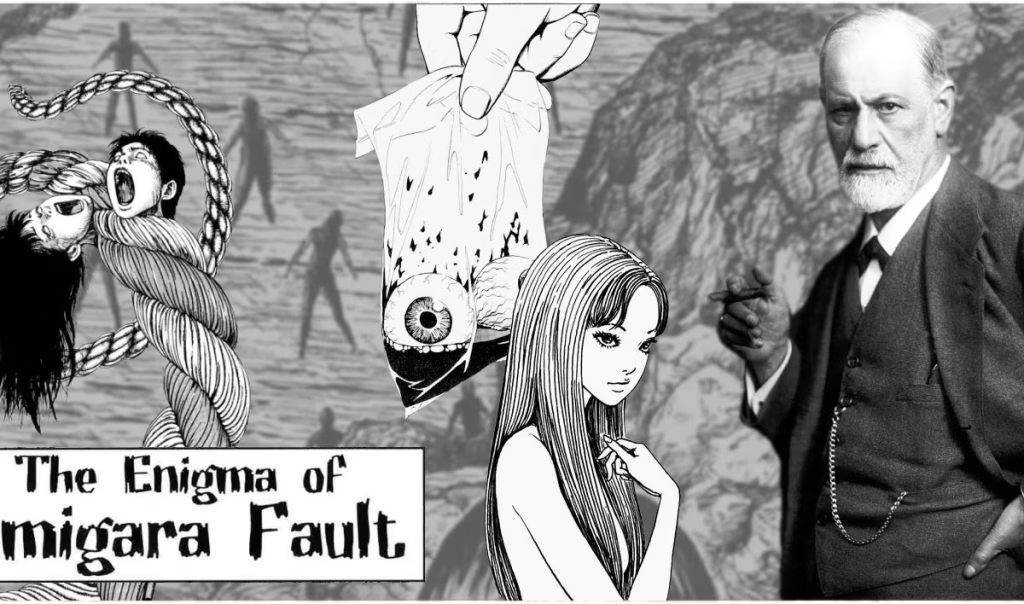
A complete guide to the plot, themes, meme legacy, and lasting dread of Junji Ito’s one-shot masterpiece.
The Enigma of Amigara Fault is a one-shot horror manga written and illustrated by Junji Ito, first published in 2001. The story follows a group of people drawn to a mountain fault line where an earthquake has revealed hundreds of human-shaped holes carved into the rock. Each hole appears to perfectly match the body of one specific person — and the pull to enter is impossible to resist.
Short, deeply unsettling, and endlessly re-readable, it has become one of the most shared horror manga on the internet. The phrase “This is my hole. It was made for me” — lifted directly from the story — became a widely recognisable meme, introducing millions of readers to Ito’s work long before they had ever picked up a manga volume.
Quick Facts
| Full Title | The Enigma of Amigara Fault (Amigara Dansou no Kaiki) |
| Author / Artist | Junji Ito |
| Author Born | July 31, 1963 — Gifu Prefecture, Japan |
| Nationality | Japanese |
| Type | One-shot manga (single chapter story) |
| First Published | 2001 |
| Publisher (Japan) | Shogakukan (in the Gyo tankobon) |
| English Publisher | Viz Media |
| Collected In | Gyo, Volume 2 (bonus chapter) |
| Pages | Approximately 30 pages |
| Genre | Horror, Psychological Horror, Body Horror |
| Key Themes | Compulsion, body horror, loss of free will, existential dread |
| Internet Fame | Source of the viral ‘This is my hole’ meme (mid-2000s onward) |
| Adapted Into? | Not officially adapted; widely referenced in internet culture |
| Available in English? | Yes — Viz Media print edition and digital platforms |
| Part of Larger Work? | Bonus story in the Gyo two-volume manga series |
| Junji Ito Known For | Uzumaki, Tomie, Gyo, Remina, Sensor, The Junji Ito Collection (anime) |
About the Author: Junji Ito
Junji Ito is widely regarded as one of the greatest horror manga artists of his generation. Born in Gifu Prefecture, Japan in 1963, he began his career in the late 1980s and built his reputation on a distinctive visual style — precise, clinical line work paired with grotesque, imagination-shattering concepts.
His most celebrated long-form works include Uzumaki (1998–1999), a town consumed by a spiral curse; Tomie, a series following an immortal femme fatale who drives men to murder; and Gyo, a story about fish walking on mechanical legs that invade Japan. Each work plays on a specific fear, but Ito’s short stories are often considered his sharpest work — and The Enigma of Amigara Fault is the best example of why.
Amigara Fault was included as a bonus chapter at the end of Gyo Volume 2. It is unconnected to the main Gyo story — it stands entirely on its own, and in the opinion of many readers, surpasses the main series it accompanies.
Plot Summary
Spoiler Warning: This section covers the full story including the ending.
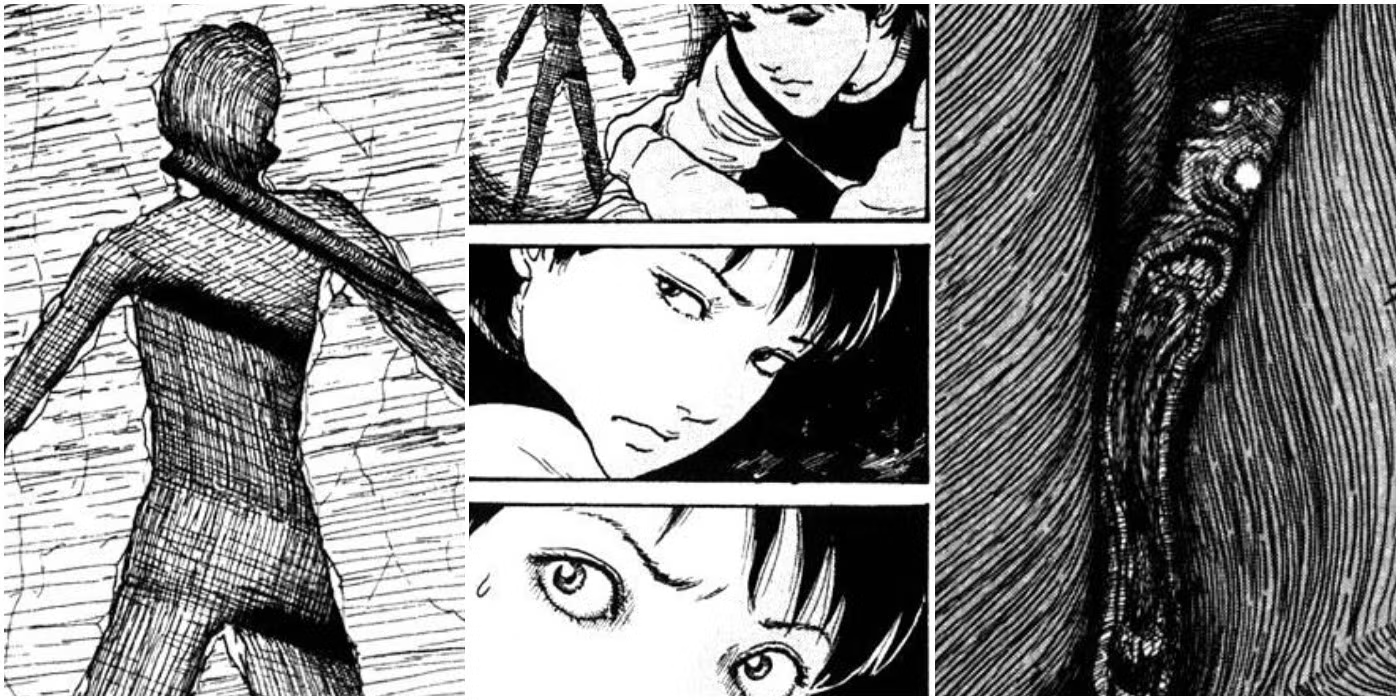
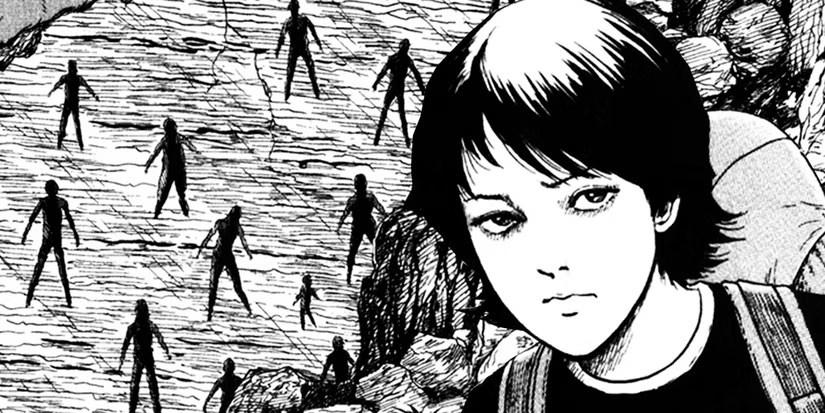
The story opens in the aftermath of a powerful earthquake along the Amigara Fault in Japan. News reports reveal that the quake has exposed a previously buried section of the mountainside — and cut into the rock face are hundreds of holes. Not caves, not crevices. Holes shaped exactly like human bodies, standing upright, arms at sides, in the precise silhouette of a person.
Two strangers, Owaki and Yoshida, are among the crowds that gather at the site. Yoshida tells Owaki she felt an inexplicable pull to come here. She cannot explain it. Then she sees one particular hole — and she knows, with absolute certainty, that it is hers. The shape matches her body perfectly. She is terrified, but she cannot stop staring at it.
Researchers attempt to study the holes. They date to well before any human civilisation — whoever carved them did so thousands of years ago, with tools and methods that remain unexplained. No one can determine how the shapes were made so precisely, or why.
One man cannot resist. He strips to his underwear in the middle of the night and enters his hole. He fits perfectly — every curve, every contour. Rescue workers try to pull him out but find it impossible. The hole seems to hold him. He is dragged deeper by something no one can see, screaming as he disappears into the mountain.
More people follow. Some willingly, some in apparent trances. Once inside, there is no coming back. The mountain consumes them completely.
Yoshida’s obsession intensifies. Owaki tries desperately to keep her away from her hole — and eventually, the two flee the site together. The story ends with Owaki waking to find Yoshida gone. He rushes back to the fault and peers into the exit point of one of the holes on the opposite side of the mountain.
What emerges — or rather, what has been squeezed out through thousands of years of narrow rock — is barely recognisable as human. The figure that crawls out of the other end has been compressed, twisted, and reshaped by the passage through the stone into something deeply, wrongly inhuman.
The final image is one of the most haunting in Ito’s entire bibliography. No explanation is given. The story simply ends.
Themes and Analysis
The Horror of Compulsion
The central terror in Amigara Fault is not a monster or a supernatural threat — it is the loss of free will. The characters are drawn to their holes not by violence or by force, but by something that feels like recognition. It is their hole. It was made for them. The horror is that they want to go in, even as they understand what will happen if they do.
This maps onto real psychological experiences — compulsive behaviour, intrusive thoughts, the strange pull of things we know are harmful. Ito takes that abstract, unsettling feeling and makes it literal. The result hits harder than most explicit gore ever could.
Body Horror and the Corruption of Form
Ito is one of the masters of body horror — the subgenre that deals with the violation, transformation, or destruction of the human body. In Amigara Fault, the body is both the lure and the victim. The holes are shaped like people, which makes them feel intimate and personal. But the exit suggests that passing through them does something catastrophic to the human form.
That final image of the deformed figure — elongated, twisted, structurally wrong — is a gut-punch precisely because Ito does not over-explain it. You understand what happened. You wish you did not.
Ancient, Unknowable Evil
The holes predate human civilisation. Whatever made them knew, somehow, the exact shape of people who had not yet been born. This is a recurring element in Ito’s work — horror rooted not in modern science or psychology but in something ancient, patient, and utterly indifferent to human understanding. There is no reasoning with it. There is no escape hatch. It simply is.
Why It Went Viral: The Meme and the Internet Legacy
In the mid-2000s, scanned translations of The Enigma of Amigara Fault began circulating on internet forums, particularly on 4chan and early Reddit communities. For many Western readers, it was their first encounter with Junji Ito — and the combination of accessibility (30 pages, self-contained, no prior manga knowledge needed) and sheer psychological impact made it spread rapidly.
The line “This is my hole. It was made for me.” became one of the earliest and most enduring horror manga memes. Used to caption everything from fitting perfectly into a cosy chair to walking into a good parking space, the meme format works precisely because the original context is so deeply unsettling. The humour comes from the collision between mundane comfort and existential dread.
The meme also did something rare — it sent people back to the source material. Ito’s readership in the West expanded enormously through this one story, and it played a meaningful role in his mainstream crossover, which eventually led to the Junji Ito Collection anime adaptation in 2018.
The Ending Explained
The ending of Amigara Fault deliberately withholds answers. We never learn who made the holes, how they were made with such precision, or what force compels people to enter them.
What the final pages do show — the deformed figure emerging from the far end of the mountain — confirms the story’s darkest implication: the holes do not simply trap you. They change you. Whatever you are when you go in, something very different comes out the other side, after being squeezed through thousands of years of rock.
Some readers interpret this as a metaphor for institutions, relationships, or ideologies that demand conformity and return something broken. Others read it more literally as ancient alien engineering, or as a manifestation of geological horror. Ito has not offered a definitive explanation, and the ambiguity is intentional. The ending is designed to stay with you precisely because there is nothing to rationalise it away.
Where to Read The Enigma of Amigara Fault
The story is published in English by Viz Media as a bonus chapter in Gyo, Volume 2. It is available in print through most major book retailers and as a digital edition through the Viz Media app, Amazon Kindle, and other digital manga platforms.
It is worth noting that the story has circulated in unofficial scanlation form online for over two decades — but the Viz Media edition offers a clean, professionally translated version that is well worth reading in its intended format.
Note: You do not need to read Gyo first. Amigara Fault is completely standalone and requires no prior context.
Conclusion
The Enigma of Amigara Fault is thirty pages long and it will stay with you for years. Junji Ito takes a single, perfectly constructed premise — holes shaped like you, carved into a mountain before you were born — and follows it to its most disturbing logical end. It is a masterclass in short-form horror, and the reason so many people’s introduction to manga came through a feeling of inexplicable, bone-deep dread.
If you have not read it, you should. If you have, you already know why it is impossible to forget.
Frequently Asked Questions
What is The Enigma of Amigara Fault?
It is a 30-page one-shot horror manga by Junji Ito, first published in 2001, about people irresistibly drawn to human-shaped holes uncovered by an earthquake in a Japanese mountain.
Who wrote The Enigma of Amigara Fault?
It was written and illustrated by Junji Ito, the Japanese horror manga artist best known for Uzumaki, Tomie, and Gyo.
Is it part of a series?
No — it is a standalone bonus chapter included at the end of Gyo Volume 2 by Viz Media. It has no connection to the Gyo story and can be read completely independently.
What is the ‘This is my hole’ meme?
A line from the manga in which a character realises a specific hole matches their body exactly. It became a viral internet meme used humorously to describe perfectly fitting into any space or situation.
How long is The Enigma of Amigara Fault?
Approximately 30 pages — short enough to read in a single sitting, which is part of why it spread so widely online.
Where can I read it legally?
In English, it is available in print and digitally as part of Gyo Volume 2, published by Viz Media. It can be purchased through major book retailers, the Viz Media app, Kindle, and other digital manga platforms.
Last Updated: 2025 | Focus Keyword: The Enigma of Amigara Fault
